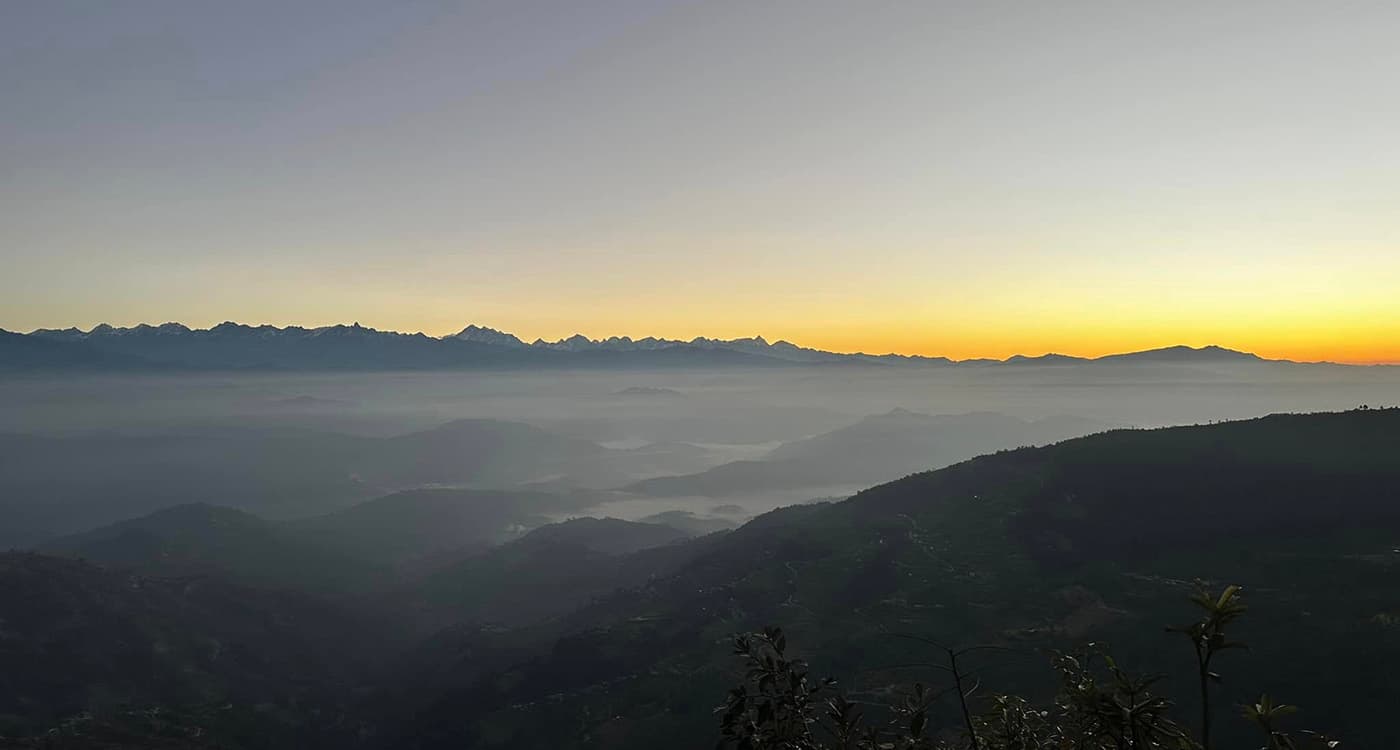
Can You See Everest from Nagarkot?
Yes — on a clear morning between October and March. Here's what to look for, when to go, and which other peaks you'll see.
Yes, you can see Everest from Nagarkot. On a clear morning between October and March, Everest (8,848m) is visible 176km to the northeast from Nagarkot's 2,175m ridge — the tallest peak on the main Himalayan ridgeline when viewed from the panoramic trail. The 6–9am window gives the clearest views before valley haze builds.
What you can actually see
On a clear November morning from the panoramic trail ridge, here are the seven major peaks visible and where to look.
The highest point on the main ridgeline. Once you know what you're looking for — the tallest peak to the right of the Langtang group — it's unmistakable.
Appears attached to Everest from Nagarkot's angle. The two summits are distinct on a very clear morning.
Visible on the clearest November mornings. A broad, pyramid-shaped peak on the far western end of the panorama.
One of the most reliable landmarks from Nagarkot — prominent enough to use as a reference point when identifying other peaks.
The closest major peak to Nagarkot and often the most dramatic. It dominates the northern horizon from the panoramic trail, especially in November.
A twin-summited peak to the east of Everest. Distinctive shape once you know what to look for.
A sharp-faced peak in the Jugal Himal range, visible to the right of Langtang on the northern horizon.
Visibility odds by month
These are real estimates based on typical conditions — not guarantees. Mountain weather is unpredictable on any given day.
| Month | Clear mornings | Clarity | Notes |
|---|---|---|---|
| October | 7 out of 10 mornings | Very Good | Best from mid-month onwards |
| November | 9 out of 10 mornings | Best | Peak visibility of the year |
| December | 6 out of 10 mornings | Good | Cold but clear |
| January | 6 out of 10 mornings | Good | Cold — dress for 2°C at 6am |
| February | 5 out of 10 mornings | Good | Improving through the month |
| March | 4 out of 10 mornings | Fair | Spring haze starts building |
| April | 3 out of 10 mornings | Fair | Early April better than late |
| May–Sep | Near zero | Poor / None | Monsoon cloud blocks the range |
Best viewpoints in Nagarkot
Panoramic Hiking Trail ridge — full guide
The best sustained view. You're on the open ridge for 2–3km with the Himalayan range visible the entire time. A local guide can point out each peak by name and position you for the best Everest angle — it's not obvious where to look without knowing the ridgeline. Takes 3–4 hours for the full loop.
Nagarkot Tower
The easiest option — a 5-minute walk from the village centre, free access, and a 270-degree view. Good for a sunrise watch without hiking. The angle is slightly different from the panoramic trail ridge, but Everest is still visible on clear mornings.
Hotel rooftops
Several Nagarkot hotels have north-facing rooftop terraces specifically for sunrise watching. Check that your hotel faces north — not all do. This is the option for people who want to watch the sunrise without moving far from bed. Bring a jacket — rooftops at 2,175m at 5:45am are cold in October and November.
When to look
The 6–8am window is non-negotiable for the best views. The atmosphere is at its clearest just after sunrise — cool temperatures keep the air dense and transparent, and no valley haze has built yet. By 9–10am on warm days, the lower ridges start to cloud over and Everest can disappear.
Late afternoon (4:30–5:45pm) is the second-best window in autumn. The low sun catches the Himalayan snowcaps and turns them orange and pink — the alpenglow effect. The views aren't as clear as morning, but the light is extraordinary.
Midday is the worst time. Heat haze in the valley floor reduces visibility significantly between 11am and 3pm regardless of season.
Nagarkot vs Everest Base Camp
Nagarkot
- Panoramic view of the full Himalayan range at 176km
- Everest visible on 7–9 out of 10 mornings (Oct–Nov)
- 1-day trip from Kathmandu — no acclimatisation needed
- $40–80 for a guided day hike
- No altitude risk — 2,175m is easy for most people
- 8 major peaks visible from one vantage point
Everest Base Camp
- Standing at 5,364m, Everest towers 3.5km directly above you
- Guaranteed close-up view of the Khumbu Icefall
- 14-day trek minimum — significant commitment
- $2,000+ budget including permits, lodges, gear
- Real altitude risks — acute mountain sickness is common
- One mountain, one focus — not a panorama
These aren't competing experiences — they're entirely different. From EBC, the scale is overwhelming because you're at the mountain's base. From Nagarkot, you see the Himalayan range as a whole, with Everest as the most recognisable point in a 300km panorama. Both are worth doing if you have the time and fitness for EBC.
Common questions
Can you see Everest from Nagarkot?
Yes. On a clear morning between October and March, Everest is visible from Nagarkot's panoramic trail ridge at 176km to the northeast. It appears as the highest point on the main Himalayan ridgeline — taller than everything to its left and right. The 6–9am window gives the clearest views.
How far is Everest from Nagarkot?
Everest is 176km from Nagarkot as the crow flies. At 2,175m altitude with no major obstacles between the ridge and the Himalayan range, that distance is enough for a clear sightline to the summit on a dry morning.
What is the best time of year to see Everest from Nagarkot?
November gives you the best odds — roughly 9 out of 10 clear mornings with sharp views. October is the second-best window, particularly from mid-month. December through February is also reliable. March and April are fair but spring haze reduces clarity. From June to September, the monsoon blocks the range almost completely.
What time of day is best to see Everest from Nagarkot?
Between 6am and 9am. That's the window before valley haze builds and before mid-morning cloud can form on the lower ridges. If you're serious about seeing Everest, start hiking before 6:30am. By 10am on many days, the range becomes partially obscured.
What other mountains can you see from Nagarkot?
On a clear November morning from the panoramic trail: Everest (8,848m) and Lhotse (8,516m) northeast, Manaslu (8,163m) northwest on very clear days, Ganesh Himal (7,422m) northwest, Langtang Lirung (7,234m) north, Gaurishankar (7,134m) northeast, and Dorje Lakpa (6,966m) north. The Langtang range is often the most dramatic — it fills the northern horizon at a much closer distance than Everest.
Is it guaranteed to see Everest from Nagarkot?
No — nothing about mountain weather is guaranteed. In November, roughly 9 out of 10 mornings are clear enough for a good view. In October, closer to 7 out of 10. Even in peak season, the occasional foggy morning happens. Starting before 6am maximises your odds. If clouds are in by 9am, the view is unlikely to improve that day.
Which viewpoint in Nagarkot has the best Himalayan view?
The panoramic hiking trail ridge gives the best sustained view — you're on the open ridge for 2–3km with the Himalayan range to the north the entire time. The Nagarkot Tower (near the village centre) is the easiest option with no hiking — a 5-minute walk for a 270-degree view. Hotel rooftops with north-facing exposure also work for a stationary sunrise watch.
How does seeing Everest from Nagarkot compare to Everest Base Camp?
Very different experiences. From EBC, you're standing at 5,364m looking up at the Khumbu Icefall with Everest's summit 3.5km directly above you — it's overwhelming and close. From Nagarkot, you're seeing the entire Himalayan range as a panorama at 176km distance — Everest is one peak among many, identifiable by its height. EBC is a 14-day trek with altitude risks and a $2,000+ budget. Nagarkot is a 1-day trip from Kathmandu. They're not competitors — they're completely different ways of experiencing the mountains.