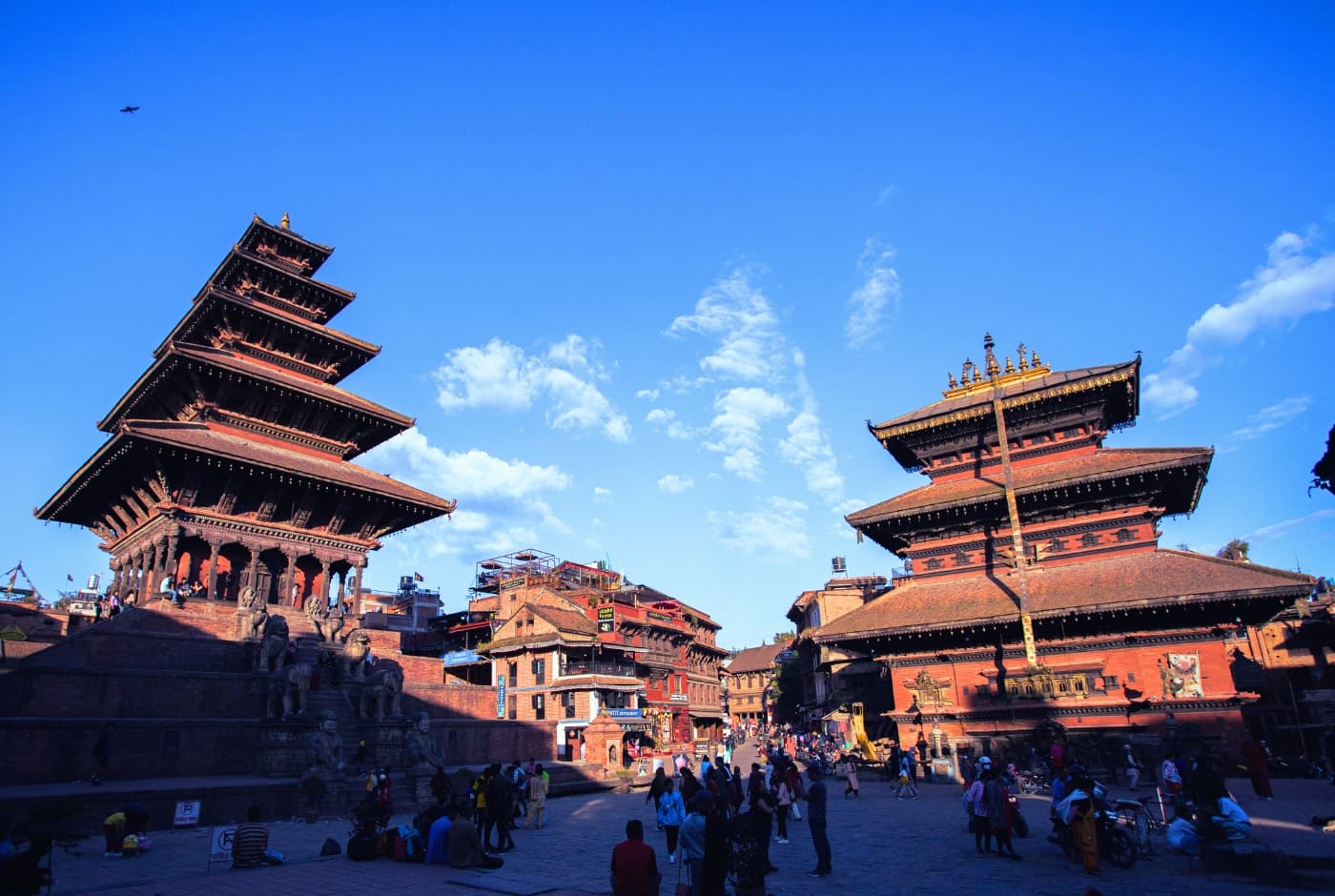
Nyatapola Temple
Five tiers, 30 metres, built in seven months. The pagoda that has stood through every earthquake while everything around it fell.
Nyatapola Temple stands at the centre of Taumadhi Square in Bhaktapur. At 30 metres, it is the tallest pagoda in Nepal — five roofed tiers rising from a broad brick plinth in the proportions of classical Newari architecture. It was built between 1702 and 1703 by King Bhupatindra Malla, reportedly completed in just seven months. That construction speed, and the temple's survival through several major earthquakes that levelled other structures, made it something of a legend in its own time.
Malla period, 1702
History
King Bhupatindra Malla was the ruler of Bhaktapur during the late Malla period and one of the most prolific builders in the Kathmandu Valley's history. His reign saw the construction of the 55 Windows Palace, the renovation of the Golden Gate, and the commissioning of Nyatapola — all within a relatively short period.
According to historical accounts, the king was concerned that the nearby Bhairavnath Temple — housing a wrathful form of the deity Bhairav — was causing disruptions in the city. He built Nyatapola and installed the goddess Siddhi Lakshmi to counterbalance Bhairav's power. The temple was dedicated to a tantric goddess whose identity is kept secret: the inner sanctum has never been opened to non-Hindus, and the exact nature of the presiding deity remains a matter of scholarly discussion.
The temple survived the 1934 Bihar-Nepal earthquake (magnitude 8.0), which destroyed or heavily damaged much of Bhaktapur and Kathmandu, and the 2015 Gorkha earthquake (magnitude 7.8), during which significant portions of Bhaktapur's Durbar Square were damaged. Nyatapola sustained minimal structural damage in both events.
Structure & symbolism
Architecture — The Five Tiers and Their Guardians
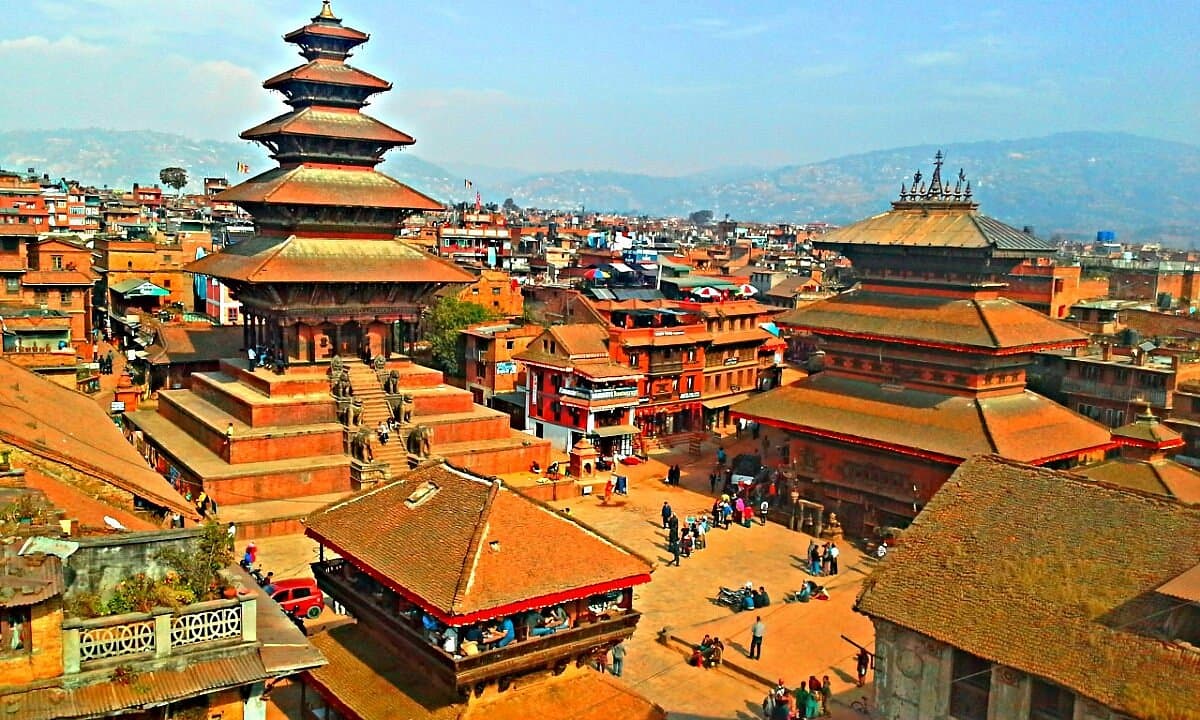
The staircase leading to the temple entrance is flanked by five pairs of guardian figures, each placed on one level of the plinth. Each pair is said to be ten times more powerful than the pair below:
- 1Jaya Mel and Phatta Mel — Bhaktapur's most famous wrestlers, said to have had the strength of ten ordinary men
- 2Elephants — Ten times the strength of the wrestlers
- 3Lions — Ten times the elephants
- 4Griffins (Gryphons) — Ten times the lions
- 5Baghini and Singhini — The tiger and lion goddesses — ten times the griffins, guarding the sanctum directly
This symbolic hierarchy conveys the power within the inner sanctum: so overwhelming that it requires ten layers of protection before reaching the deity.
The five roofed tiers are built in diminishing size — each smaller than the one below — creating a visual tapering that makes the height seem even greater than 30 metres. The proportions follow classical Newari architectural ratios: the plinth base is wide enough to anchor the structure visually and structurally, which engineers credit as a significant factor in its earthquake resistance.
The square
Taumadhi Square — The Context
Nyatapola stands opposite Bhairavnath Temple across Taumadhi Square — a deliberate counterbalance. The fearsome Bhairav required the power of Siddhi Lakshmi to contain him. The architectural dialogue between the two temples, one soaring and serene and one low and fierce, defines the character of the square.
Taumadhi is quieter than Bhaktapur's Durbar Square. Fewer vendors, more locals using it as a thoroughfare, children playing on the temple steps in the afternoon. Rooftop cafes on the square's eastern edge offer the best elevated view of Nyatapola — worth sitting at for at least 30 minutes.
Practical info
Visiting Nyatapola — What to Know
Entry ticket
Nyatapola is included in the Bhaktapur city ticket. Foreigners: NPR 1,800 (US$18). SAARC nationals: NPR 500. Children under 10: free. No separate ticket is required.
Full entry fee guideAccess for non-Hindus
The inner sanctum is closed to non-Hindus. The full exterior, the staircase plinth, and the guardian figures are open to all visitors. You can climb the first level of steps.
Best time to visit
Morning light comes from the east and hits the front face of the temple directly — the best window for photography. Golden hour (5–6pm) produces warm light on the brick.
Photography
The full height of Nyatapola is easiest to capture from the far end of Taumadhi Square or from a rooftop cafe. A wide-angle lens or stepped back phone shot works at ground level.
Getting there
Taumadhi Square is a 10-minute walk from Bhaktapur's main Durbar Square. From Kathmandu, Bhaktapur is 15km — about 45–60 minutes by taxi.
Transport guideCombine with
Nyatapola is naturally combined with the rest of Bhaktapur's four squares in a half-day or full-day visit. Add a Nagarkot sunrise the same morning for the full experience.
Nagarkot + Bhaktapur tourCommon questions
Has Nyatapola Temple survived earthquakes?
Yes, notably. The temple stood through the 1934 Bihar-Nepal earthquake (magnitude 8.0), which destroyed or heavily damaged a large part of Bhaktapur and Kathmandu, and through the 2015 Gorkha earthquake (magnitude 7.8), during which significant portions of Bhaktapur's Durbar Square were damaged. Nyatapola sustained minimal structural damage in both events — a record attributed to its proportionally wide plinth base and the quality of its Malla-era construction.
Who built Nyatapola Temple and why?
Nyatapola Temple was built by King Bhupatindra Malla of Bhaktapur in 1702 CE. According to historical accounts, the king was concerned that the Bhairavnath Temple across Taumadhi Square — housing a wrathful deity — was causing disruptions in the city. He built Nyatapola and installed the goddess Siddhi Lakshmi to counterbalance Bhairav's power. The temple was reportedly completed in just seven months.
Is Nyatapola the tallest temple in Nepal?
Nyatapola is the tallest pagoda in Nepal at 30 metres. It holds the record specifically for the tiered pagoda form of architecture. There are taller structures of other architectural types in Nepal, but no other traditional Newari pagoda temple exceeds Nyatapola's height. Its five tiers and the tapering proportions make it appear even taller than the measurement suggests.